

class=”story”>
National
Содержание статьи:
Trump has sued universities for billions. Here’s what the strategy tells us January 29, 20265:00 AM ET
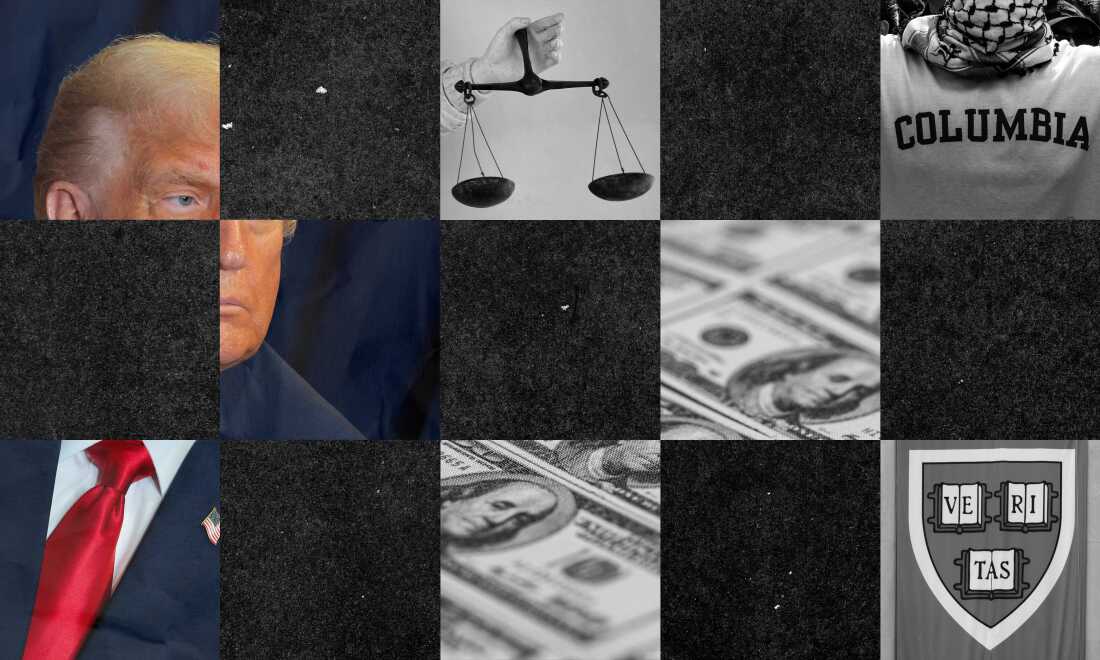
The Trump administration has focused its efforts on using funding to affect policies at elite schools. Getty Images/Photo illustration by Emily Bogle/NPR hide caption
toggle caption Getty Images/Photo illustration by Emily Bogle/NPR
A year ago, President Trump issued an executive order that put U.S. universities on notice. The Jan. 29, 2025, directive targeted antisemitism on campus and launched investigations at five schools — later widened to 60.
But within weeks of the executive order, federal agencies started withholding billions of dollars in contracts and grants from several high-profile schools and pressuring them to align their policies more closely with Trump’s on a range of issues that extended beyond antisemitism.

The NPR Politics Podcast
How the Trump administration is pressuring universities to fall in line
Elite universities soon began reaching settlements, starting with the University of Pennsylvania and Columbia University in July. Harvard University was a notable exception, challenging the administration’s actions in court. In September, a federal judge ruled in Harvard’s favor that the government illegally froze more than $2 billion in federal grants and contracts, a decision the government is appealing. Despite Harvard’s victory, more schools agreed to deals.
Some universities paid the government millions of dollars; others paid nothing but agreed to policy or personnel changes. But a common theme has emerged over the past year: The administration is seeking to alter the culture at these powerful institutions, barring them, for instance, from supporting programs aimed at diversity, equity and inclusion.
Sponsor Message
Loading…
What is the administration’s goal? And can it do that?
Universities have stressed that reaching a settlement doesn’t mean they admit to any wrongdoing. But the deals have called for colleges to agree to policy changes, like adopting definitions of gender as laid out by the president’s executive orders, affecting everything from campus housing to athletic programs.
“In just a year, President Trump has completely transformed American higher education by restoring merit, enforcing civil rights, and eliminating waste, fraud, and abuse,” White House spokesperson Liz Huston told NPR in an email. Huston said the Trump administration “will keep holding even more [higher education institutions] accountable over the next three years — to promote academic excellence and maintain America’s advantage for generations to come.”

Education
As deadline for Trump’s colleges compact looms, schools signal dissent
But Trump’s use of federal funds to force changes has raised questions from constitutional scholars about whether his tactics violate the law.
“What I find striking and disturbing about what’s happened here,” says Thomas Berry, the director of constitutional studies at the libertarian Cato Institute, “is that the federal government started by simply pausing all of this funding” without proving its allegations.
Berry says that Cato doesn’t love the idea of private universities being dependent on federal funds. But he also says the government shouldn’t use that relationship to meddle in how schools would normally operate.
Sponsor Message
“To me, it’s a blatant violation of the unconstitutional conditions doctrine of the First Amendment,” says Berry.
The idea behind that doctrine is that a government can’t say someone has to give up a constitutional right such as free speech or they won’t get a benefit — like federal money.
Echoing Berry’s point, Todd Wolfson, president of the American Association of University Professors, says, “Six or seven [Supreme Court] rulings from 1920 onwards all held that the federal government cannot use purse strings to control speech.”

Education
Judge indefinitely bars Trump from fining UC over alleged discrimination
The government has formal processes to enforce civil rights statutes and court rulings, but Berry says the Trump administration isn’t using those tools. Instead, he says, the administration seems to be channeling Trump’s history of filing lawsuits to accomplish his business and personal goals.
“Trump has such a long history as a private citizen of suing individual people or individual entities and dealing with them one at a time,” he says. “But it’s concerning when it’s from the federal government.”

Media
Paramount agrees to pay $16 million to settle Trump’s CBS lawsuit
The American Association of University Professors has sued the Trump administration in several venues over its withholding of funds and grants. Its president, Wolfson, is blunt in characterizing the settlements.
“It was extortion.”
He also says the government’s actions are unconstitutional and undermine academic freedoms, while endangering research projects that can benefit the American public.
Still, the government secured significant payments and concessions from a slate of well-regarded universities in 2025:
Northwestern University:
- The Illinois school agreed in late November to pay $75 million to the government over three years to unlock some $790 million in frozen federal money and end civil rights investigations by several agencies.
- The Trump administration had accused Northwestern of allowing antisemitism to spread on campus, related to protests against Israel’s attacks on Gaza.
- Northwestern’s interim president, Henry Bienen, said that the university had been paying some $40 million every month to maintain research and that the deal was “the best and most certain method” to restore federal funding. A legal battle would likely have lasted for years, he said.
- Policy changes that Northwestern agreed to included terminating the Deering Meadow Agreement, a 2024 pact with demonstrators under which the university had, among other things, provided temporary space for two Middle Eastern and Muslim student groups.
Sponsor Message
Cornell University:
- Faced with losing more than $250 million in federal funds, Cornell announced a deal with the government on Nov. 7. The government closed civil rights investigations that focused on Cornell’s compliance with antidiscrimination laws in its admissions procedures.
- Cornell will pay a total of $60 million over three years: $30 million to the government and $30 million for “research to strengthen U.S. agriculture,” according to the university’s president, Michael Kotlikoff.
- Cornell also agreed to use guidance from the Justice Department “as a training resource to faculty and staff.” That July 2025 memo from Attorney General Pam Bondi equates DEI programs to “discriminatory practices.”
University of Virginia:
- UVA’s interim president, Paul Mahoney, signed a deal with the Justice Department on Oct. 22, months after then-President Jim Ryan resigned. Ryan had said the federal government threatened to gut funding if he remained. The university received more than $400 million in federal research funds in the 2024 financial year.
- The Justice Department had opened seven investigations into UVA in nine weeks, many of them related to the school’s response to Trump’s order to end diversity, equity and inclusion initiatives.
- UVA isn’t required to pay a fine or set up an external monitor of its practices. The school affirmed it will follow civil rights laws, and it also agreed to adopt Bondi’s guidance on what constitutes discrimination.
Brown University:
- On July 30, Brown University agreed to pay $50 million over 10 years to local workforce development organizations. The deal emerged after the White House said it would freeze $510 million of federal funding due to allegations of antisemitism on Brown’s campus and the school’s diversity, equity and inclusion work.
- Under the deal, Brown also pledged to adopt definitions of “male” and “female” as laid out in a Trump executive order, and to not consider race in its admissions and programming.
Columbia University:
- In late July, the White House and Columbia University said the university would pay some $221 million to resolve several investigations, as NPR reported. The school previously said the government suspended “the majority” of $1.3 billion in federal research funding.
- The settlement calls for Columbia to pay $200 million over three years related to the administration’s allegations of discriminatory practices, and $21 million to settle an investigation into workplace harassment related to the college’s Jewish employees.
- Among other measures, the settlement stipulates that Columbia won’t consider race in admissions, programming or hiring, will provide a demographic and academics breakdown of all rejected and admitted students, and will review its international admissions process.
Sponsor Message
University of Pennsylvania:
- On July 1, the school, Trump’s alma mater, reached an agreement that included revising records related to a transgender swimmer’s results, as well as its policies on transgender athletes, after the Trump administration froze $175 million of federal funding. In 2022, Lia Thomas, a transgender athlete at Penn, won high-profile swimming titles at the women’s Ivy League championships.
- Donald Trump
- Harvard
- Education
